Our Approach: The Save & Spend System™
The Save & Spend System™ is the four-stage framework The Cash Compound™ uses to walk clients through their whole financial picture: Security, Savings, Strategy, and Significance. The first two stages make up Financial Foundations. The last two make up Financial Freedom. Each stage builds on the one below it.
The Cash Compound™ is a licensed insurance agency, not a FINRA-registered firm, and nothing here is securities, investment, or tax advice. See the disclosures at the bottom of this page.
What is the Save & Spend System™?
The Save & Spend System™ is a framework for organizing your financial life in four stages, from protecting what you have to deciding what your wealth is for. It's built on one simple idea: you should be able to save your money, let it compound, and still buy the things you need and want.
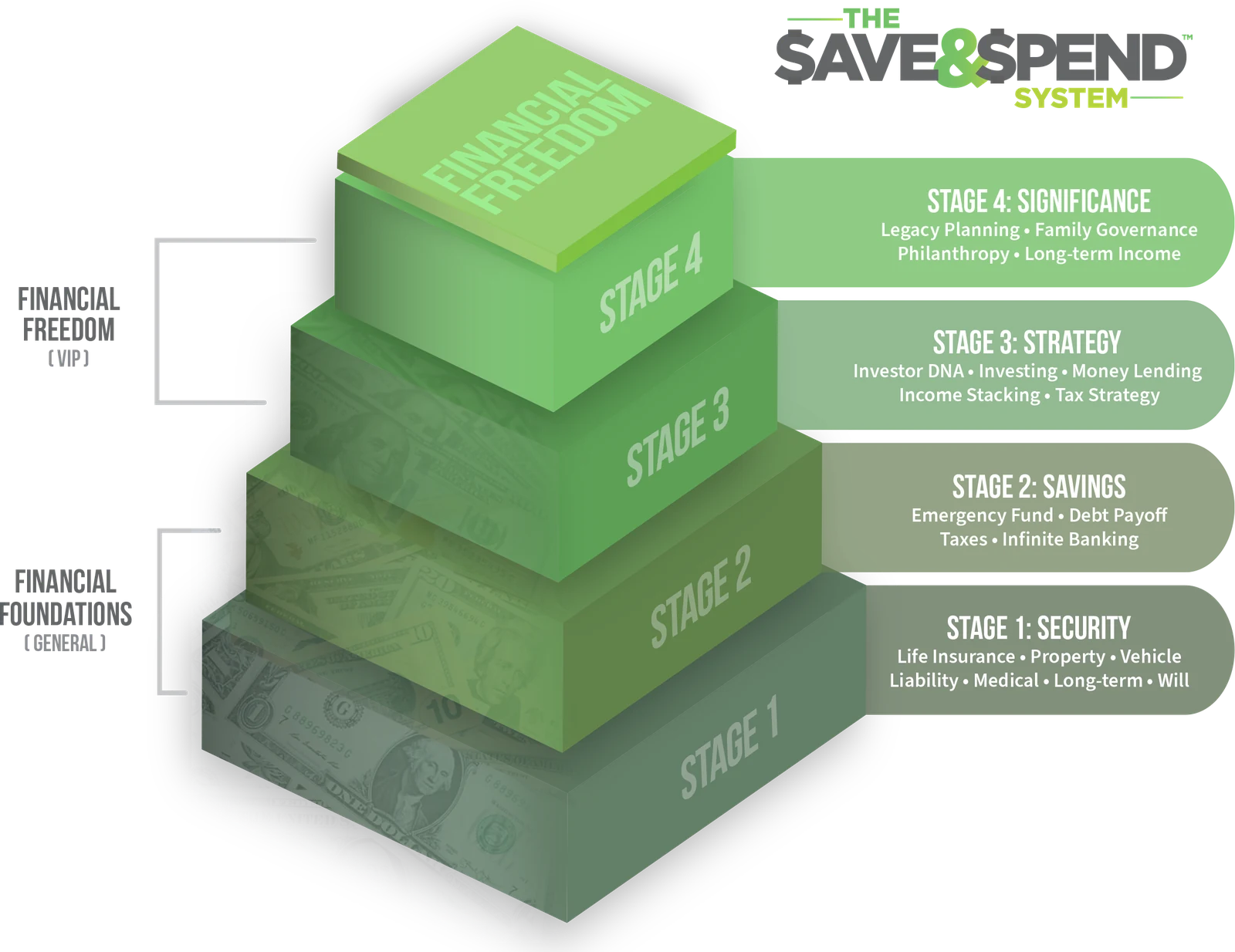
The four stages at a glance
| Stage | Name | Grouping | Areas it covers |
|---|---|---|---|
| 1 | Security | Financial Foundations | Life insurance; disability and income protection; property and vehicle protection; liability protection; health and long-term care planning; essential legal documents |
| 2 | Savings | Financial Foundations | Cash flow and budgeting; savings; emergency fund; planned expenses and taxes; debt management; Infinite Banking implementation |
| 3 | Strategy | Financial Freedom | Investor DNA; finding and evaluating opportunities; your investing game plan; investing and money lending; income sources; tax strategy |
| 4 | Significance | Financial Freedom | Long-term income; legacy planning; family communication and decisions; giving and philanthropy; business succession planning |
Financial Freedom sits at the top of the pyramid. It's the goal the whole system points toward, not a promise of a result.
What The Cash Compound™ offers at each stage
The Save & Spend System™ covers far more than insurance, but our products are insurance. We work in life insurance and fixed annuities. We don't offer or sell securities. For Infinite Banking, that means specially designed whole life insurance used to apply The Infinite Banking Concept®.
For the other areas in the framework, such as property, health, legal documents, investing, lending, taxes, and business succession, we help you see where each one fits in your plan. Decisions in those areas should be made with qualified professionals, such as an attorney, a tax professional, or a licensed advisor in that field.
The Infinite Banking Concept® is a registered trademark of Infinite Banking Concepts, LLC. The Cash Compound™ is independent of and is not affiliated with, sponsored by, or endorsed by Infinite Banking Concepts, LLC, and it isn't endorsed by the Nelson Nash Institute.
Financial Foundations (Stages 1 and 2)
Financial Foundations is the base of the pyramid. These two stages cover protecting your household and getting your everyday money organized.
Stage 1: Security. Protect your foundation.
Security is about protection and preparedness. Before money is put to work, it helps to know what would happen to your household if something went wrong. In Stage 1 we look at:
- Life insurance. Your household's protection needs, the types and amounts of coverage you have, who owns each policy, who the beneficiaries are, and any conversion deadlines.
- Disability and income protection. The employer and individual coverage you already have, benefit amounts, waiting periods, how long benefits last, and any income gaps that remain.
- Property and vehicle protection. Homeowners or renters coverage, your vehicles, replacement provisions, deductibles, exclusions, and any other exposures that apply to you.
- Liability protection. Personal liability, umbrella coverage where appropriate, and business exposures that apply.
- Health and long-term care planning. Your medical coverage and out-of-pocket exposure and, separately, how extended care needs would be handled.
- Essential legal documents. Wills, guardianship provisions where they apply, financial powers of attorney, healthcare directives, and trusts where appropriate.
Life insurance is the part of Stage 1 we offer. For the rest, we help you take stock, and you work with the right professional or provider for each one.
Stage 2: Savings. Build accessible capital.
Savings is about saving habits and cash flow, and it's the stage where Infinite Banking fits. In Stage 2 we look at:
- Cash flow and budgeting. Understanding your income, spending, commitments, and available surplus, and deciding where your money should go.
- Savings. Setting a savings amount you can keep up, choosing where to save, and contributing consistently toward defined goals.
- Emergency fund. Setting a target that fits your household for unexpected expenses or income interruptions, building the fund, and understanding how you'd access it.
- Planned expenses and taxes. Preparing for the bills and obligations that don't arrive every month.
- Debt management. Listing your debts, keeping payments current, and following an agreed payoff plan.
- Infinite Banking implementation. Understanding your policy, keeping up its funding, monitoring its available values, and managing any policy loans and repayment.
Infinite Banking applies the ideas in Becoming Your Own Banker® by R. Nelson Nash, using a specially designed whole life insurance policy. A policy loan is a loan from the insurance company, secured by your policy's cash value, and it accrues interest. How policy loans work and how they can affect your policy are explained in the disclosures at the bottom of this page.
Becoming Your Own Banker® is a registered trademark of Infinite Banking Concepts, LLC.
Financial Freedom (Stages 3 and 4)
Financial Freedom is the top of the pyramid. These two stages cover putting your capital to work and giving your wealth a purpose. They rest on the foundation built in Stages 1 and 2.
This is general education, not personal financial, tax, or legal advice.
Stage 3: Strategy. Put your capital to work.
Strategy is about how you choose to use your capital. Infinite Banking isn't investing, but you may still decide to use investing as part of your overall plan. In Stage 3 we help you think through:
- Investor DNA. What kind of investor you want to be: your goals, your experience, your comfort with risk, and how involved you want to be.
- Finding and evaluating opportunities. What to look for, which questions to ask, and how to assess an opportunity before you commit money.
- Your investing game plan. How much money you can put to work, what needs to stay accessible, and how each decision supports your goals.
- Investing and money lending. The different ways people put capital to work, including investing and private lending where appropriate.
- Income sources. Where your income comes from, how to strengthen the sources you have, and which additional sources fit your goals, while tracking what each one produces after expenses and debt payments.
- Tax strategy. How investments, business activities, and ownership arrangements affect your taxes, worked out with qualified tax professionals.
These are planning conversations, not recommendations. We don't offer or sell securities, and we don't arrange investments or private loans. Any investment, lending, or tax decision should be made with qualified professionals, and every investment carries risk.
Stage 4: Significance. Give your wealth a purpose.
Significance is about stewardship, family legacy, generosity, and preparing the next generation. In Stage 4 we look at:
- Long-term income. How your resources will support your household over time.
- Legacy planning. Who receives what, and how your wishes are carried out.
- Family communication and decisions. How your family talks about money, makes decisions, and prepares future generations.
- Giving and philanthropy. A purposeful plan for supporting the people, causes, and organizations you care about.
- Business succession planning. For business owners, preparing for who will own and lead the business when you step away.
Legal, estate, and succession arrangements are put in place with an attorney and other qualified professionals.
Why the stages come in this order
The pyramid is built from the bottom up. Security comes first because protection is the base everything else stands on. Savings comes next so you have organized cash flow and accessible capital. Strategy and Significance build on that foundation. Most people work on more than one stage at a time, and where you start depends on where you are today.
How we walk clients through each stage
- Learn first. Watch the free presentation, where we walk through The Save & Spend System™.
- Talk it through. Book a free Cash Consultation with a licensed producer.
- Decide together. You decide whether working together makes sense for you.
Frequently asked questions
What is the Save & Spend System™?
The Save & Spend System™ is a four-stage financial framework from The Cash Compound™. It moves from Security to Savings, then Strategy, then Significance. Stages 1 and 2 form Financial Foundations, and Stages 3 and 4 form Financial Freedom. It's built on the idea that you can save, let your money compound, and still buy what you need.
What are the four stages?
The four stages are Security, Savings, Strategy, and Significance. Security covers protection such as life insurance and legal documents. Savings covers cash flow, emergency funds, debt, and Infinite Banking. Strategy covers investing, income sources, and tax planning. Significance covers long-term income, legacy, family decisions, giving, and business succession.
Where does Infinite Banking fit?
Infinite Banking fits in Stage 2, Savings. It uses a specially designed whole life insurance policy to apply The Infinite Banking Concept®. In this stage we look at understanding your policy, keeping up its funding, monitoring its available values, and managing any policy loans and repayment. Infinite Banking isn't investing.
What's the difference between Financial Foundations and Financial Freedom?
Financial Foundations covers Stages 1 and 2, Security and Savings: protecting your household and organizing your everyday money. Financial Freedom covers Stages 3 and 4, Strategy and Significance: putting capital to work and giving your wealth a purpose. Foundations comes first because the upper stages build on it.
Which stage am I in, and where do I start?
Most people have pieces in place across several stages. The simplest way to find your starting point is to watch the free presentation, then book a free Cash Consultation. A licensed producer will talk through your situation with you, and you decide whether working together makes sense.
How does The Cash Compound™ help at each stage?
We work in life insurance and fixed annuities, so our products fit mainly in Stage 1, with life insurance, and Stage 2, with Infinite Banking. In the other areas, we help you see how each one fits your plan, and you make those decisions with qualified professionals. We don't offer or sell securities.
Find your stage
Book a free Cash Consultation and talk with a licensed producer about where you are in The Save & Spend System™.
This is general education, not personal financial, tax, or legal advice.